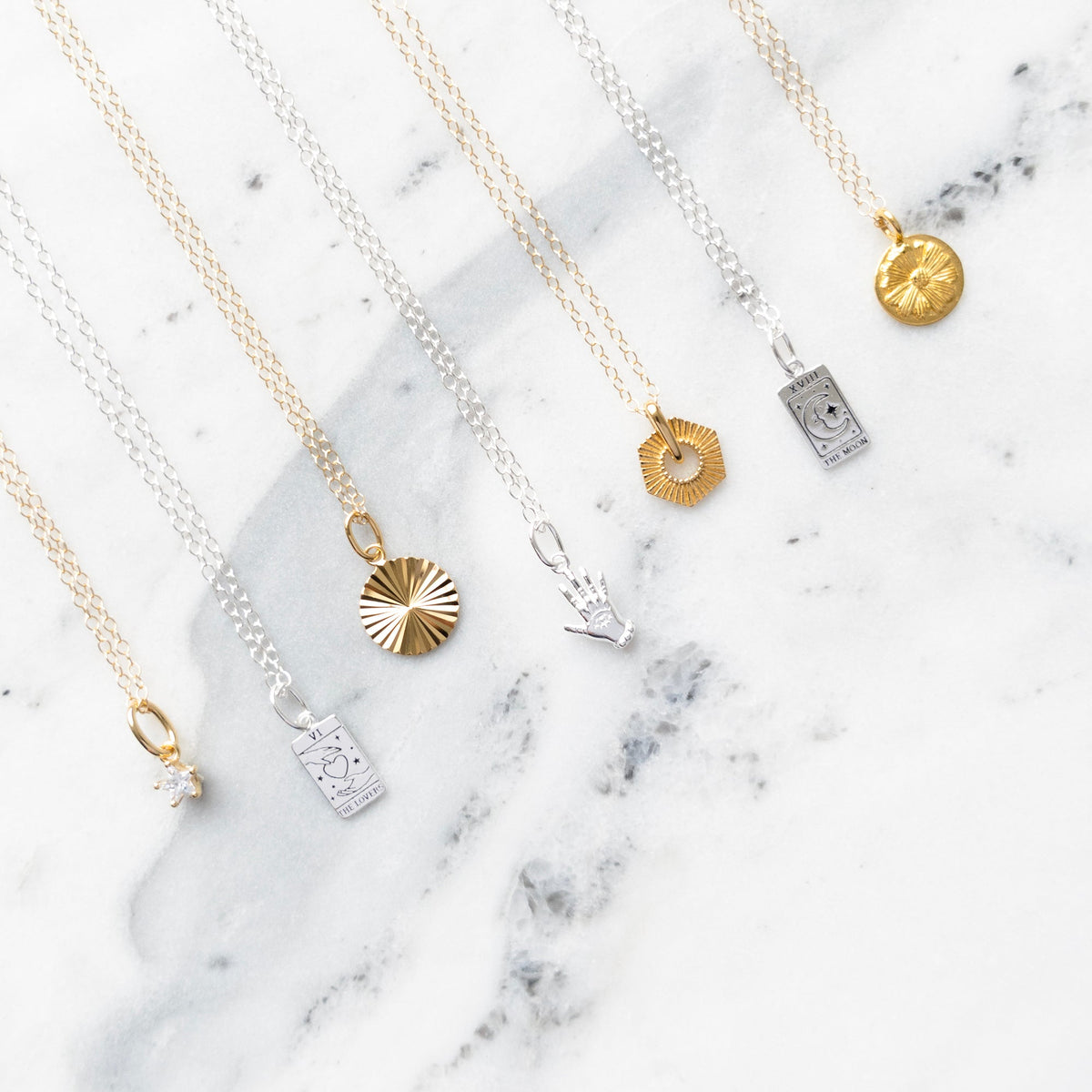




Minimalist jewellery gets talked about constantly. Usually in the same recycled terms—"dainty," "effortless," "chic"—that tell you nothing useful about what it actually is or why it might be worth your time.
So let's be more precise.
What Is Minimalist Jewellery?
Minimalist jewellery is defined by design, not size. Clean lines. Simple forms. Every detail intentional, nothing added without reason.
It comes down to three principles:
- Simplicity — clear, considered design without excess
- Versatility — pieces that work across outfits, occasions, and seasons
- Longevity — styles and materials built to last, not to be replaced next year
What you're left with is jewellery that slots into real life without demanding constant attention. A fine chain that works with everything. Stacking rings you forget you're wearing. Studs that don't require outfit planning.
It's not about wearing less. It's about wearing better.
The Different Types of Minimalist Jewellery
Necklaces. Fine chains are the backbone of minimalist jewellery. Worn alone or layered. Pendants stay simple: circles, bars, ovals, subtle stones. Nothing that announces itself before you do.
Rings. Slim bands designed to stack. Clean shapes with just enough detail to hold interest without hijacking the rest of the outfit. A plain band. A thin twisted wire. A tiny stone set flush.
Earrings. Studs, small hoops, understated geometric shapes. Pieces that frame the face without competing with it. The kind you put on in the morning and stop thinking about.
Bracelets. Delicate chains, slim bangles, simple cuffs. The minimalist approach here is the same: low profile, high wearability.

A Brief Context: Why Minimalist Jewellery Emerged
Minimalism in jewellery didn't appear from nowhere. It was a reaction—to maximalism, to fast fashion excess, to the disposable jewellery that tarnished after three wears and ended up in a drawer.
The design philosophy borrows from broader minimalism: remove what doesn't serve a purpose. Keep what does. The result is jewellery that feels considered rather than accumulated.
It also reflects a shift in how people want to dress: fewer, better things. A capsule wardrobe logic applied to accessories.
Minimalist Doesn't Mean Generic
There's a version of minimalist jewellery that strips things back so far it becomes completely boring. That's not the goal.
Simple design leaves plenty of room for personality, it's just expressed through detail rather than scale. A fine chain with a tiny heart. A slim ring with a celestial motif. Studs with a slightly offbeat shape.
Same principles. Different personality.
At Oh My Clumsy Heart, this is exactly the balance we work with. Our pieces are made from recycled sterling silver and gold, kept deliberately simple in form—but never stripped of character. Minimalist doesn't have to mean anonymous.
How to Wear Minimalist Jewellery
This is where minimalist jewellery earns its reputation.
Layering necklaces. Start with a choker or short chain, add a mid-length fine chain, finish with something slightly longer—a pendant or plain chain at collarbone to chest length. Keep metals consistent. Vary lengths by at least 2 inches so they don't tangle or compete.
Stacking rings. Mix textures subtly—a plain band next to a lightly hammered one, for example. Wear across multiple fingers or stack on one. The rule: if it looks deliberate, it works.
Combining earrings. If you have multiple piercings, minimalist studs in different sizes read as intentional without looking overdone. A small hoop in one hole, a flat stud in another.
The everyday formula. Fine chain necklace + stud earrings + one or two stacking rings. That's it. Works for a desk, a dinner, a weekend. No decisions required.
The versatility isn't accidental, it's designed in.

Why Minimalist Jewellery Works for Everyday Wear
Most people don't want to think about their jewellery every morning. It needs to work immediately, with every outfit, without negotiation.
Minimalist pieces are built for exactly that. They go with everything. They're comfortable enough to forget about. They layer without clashing. Over time, they stop feeling like accessories and start feeling like part of you.
Statement pieces have their place—but they can only be worn in certain situations, with specific outfits. Minimalist jewellery goes anywhere. A fine chain works with a blazer, a t-shirt, or swimwear. A slim ring makes equal sense at a desk or at dinner.
Materials Matter More Than Design
When design is simple, there's nowhere for poor quality to hide. If it's delicate and badly made, it won't last—and lasting is the whole point.
What to look for:
- Solid gold (9ct or 14ct) — doesn't tarnish, built for constant wear
- Sterling silver (925) — durable, repairable, widely recyclable
- Gold vermeil — thick gold layer over sterling silver (minimum 2.5 microns to meet the standard)
- Gold fill — significantly more durable than standard plating
- Recycled metals — same quality, lower environmental impact
At Oh My Clumsy Heart, we use recycled sterling silver and gold across our range. Same quality, less impact—and a material that can genuinely handle being worn on repeat.
What to avoid:
- Gold-plated brass — thin coating that wears quickly and exposes base metal
- Vague "sustainable" claims — no specifics usually means no standards
If the material fails, the design becomes irrelevant very quickly.
How to Build a Minimalist Jewellery Collection
You don't need more jewellery. You need better jewellery.
Start with:
- Everyday earrings — studs or small hoops
- A fine chain necklace — works alone or layered
- A small pendant — something with meaning or variation in length
- A few stacking rings — comfortable enough to leave on
- One optional statement piece — that still fits your overall aesthetic
Then build slowly. Another chain length. A slim bracelet. New studs. Pieces that expand your options without disrupting everything else.
The goal isn't quantity. It's a small, cohesive set that works together—and works every day.

FAQ
What is the difference between minimalist jewellery and dainty jewellery?
"Dainty" refers to size. "Minimalist" refers to design. A bold, smooth band can be minimalist. A tiny ornate pendant isn't. Scale isn't the defining factor—intention is.
Is minimalist jewellery still in style?
Yes, and it always will be. Simple, well-made pieces don't date the way trend-led jewellery does. A clean gold ring looked good twenty years ago and will look good in twenty more.
How do you layer minimalist jewellery without it looking messy?
Keep metals consistent, vary necklace lengths by at least 2 inches, and don't overload. Two or three pieces layered looks considered. Six looks chaotic.
What is the best metal for minimalist jewellery?
For everyday wear: solid gold (9ct or 14ct) or sterling silver (925). Both handle constant wear. Gold vermeil or gold-fill is a good middle-ground if you want the gold look at a lower price point.
Why is minimalist jewellery sometimes more expensive?
Because it relies on quality materials and construction rather than trend-led design. Better metals, thicker plating, and considered production cost more—but they also last, which makes them cheaper in the long run.
Is minimalist jewellery sustainable?
Not automatically. It depends on materials, sourcing, and how it's made. Minimal design alone doesn't make something ethical. Look for specifics: recycled metals, responsible sourcing, transparent production.
Minimalist jewellery isn't about being small or forgettable. It's about timeless design, quality materials, and pieces that earn their place in your everyday life.
Fewer pieces. Better decisions. Jewellery that gets worn, not saved for later.
Not less for the sake of it. Just less—done properly.
Oh My Clumsy Heart makes everyday minimalist jewellery from recycled sterling silver and gold—designed to be worn on repeat, not saved for best.